CO/Gas Alarm Troubleshooting
Find USI carbon monoxide and natural gas alarm troubleshooting guides for beeping, warning lights, error codes, replacement, and model-specific support.
Related Topics:




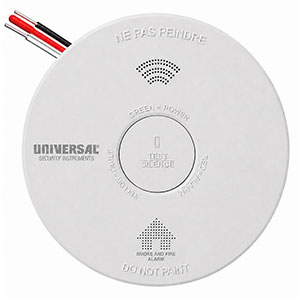

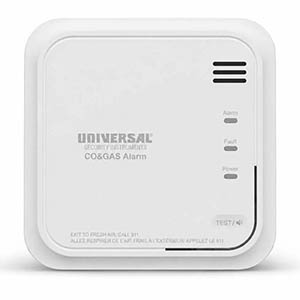
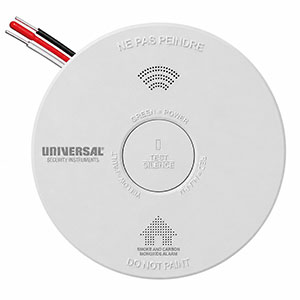
How long does a carbon monoxide detector last, and how can you tell when a natural gas alarm needs replacing? Even if your Universal Security Instruments (USI) detector appears to be working normally, its sensing components have a limited operating life.
Knowing when to replace a carbon monoxide or natural gas alarm helps ensure your home continues to have reliable protection against dangerous CO exposure and combustible gas leaks.
Many newer USI carbon monoxide and natural gas alarms are designed for approximately 10 years of operation, while several older USI Electric combination models specify a seven-year service life. The correct replacement schedule depends on your exact model, its manufacture or activation date, and the instructions supplied by the manufacturer.
This guide explains how long USI alarms last, where to find replacement information, what end-of-life chirps mean, and how to select an appropriate replacement.
Newer 10-year models: Replace the entire alarm when it reaches its specified 10-year service life, printed replacement date, or confirmed end-of-life warning, whichever requires action first.
Older 7-year models: Several legacy USI Electric CO and natural gas alarms require replacement after approximately seven years of operation from initial activation.
Replace sooner when necessary: An unresolved sensor fault, depleted sealed battery, failed test, or damaged detector may require replacement before its scheduled expiration.
Check your exact model: Always use the replacement date or service-life instructions specified for your particular alarm. Not every detector has the same lifespan.
Carbon monoxide and natural gas alarms contain electronic sensing components that can deteriorate over time. As these components age, the detector may become less reliable at recognizing hazardous gas concentrations.
Replacing batteries, cleaning the housing, and performing regular tests can help maintain an alarm, but these activities do not extend the rated lifespan of its sensors.
Universal Security Instruments offers both newer 10-year models and older alarms with shorter service-life requirements.
| USI Model | Alarm Type | Power Source | Specified Service Life |
|---|---|---|---|
| USI/NGCO/10YR | Natural Gas & Carbon Monoxide | Sealed 10-year lithium battery | 10 years |
| USI/NG/10YR | Natural Gas Only | Sealed 10-year lithium battery | 10 years |
| USI/CO/REP | Carbon Monoxide Only | 2 replaceable AA batteries | 10 years |
| USI/CO/PLUG | Carbon Monoxide Only | Plug-in AC power with 2 AA backup batteries | 10 years |
| MC304SB | Carbon Monoxide Only | Sealed 10-year battery | 10 years |
Important: These are manufacturer-described service-life specifications, not guarantees that every detector will operate without problems for the full period. Replace an alarm earlier if its warning indicators, condition, or user manual require it.
Also remember that a carbon monoxide-only detector, such as the USI/CO/REP or USI/CO/PLUG, does not detect natural gas. The USI/NGCO/10YR is designed to detect both hazards, while the USI/NG/10YR detects natural gas only.
The best way to determine when your alarm needs replacement is to check its product label and original user manual.
Depending on the model, the alarm may display a manufacture date, replacement date, or other service-life information.
Locate the USI model number on the detector's product label, packaging, or original documentation.
Common model numbers include:
The model number is important because similar-looking detectors may have different replacement requirements.
Check the label for wording such as "Date of Manufacture," "Replace By," or another manufacturer-specified service-life date.
Some detectors calculate their service life from manufacture, while others identify a specified period of operation after activation. A printed replacement date should not be ignored simply because the alarm was purchased or installed more recently.
Always follow the date and replacement instructions specified for your model.
If your manual specifies a service life measured from activation, review your original installation records to determine when the alarm was first powered.
Example: An older USI combination alarm activated in November 2019 with a specified seven-year operating life would reach that interval in November 2026.
A newer detector with a 10-year service life may have a later replacement deadline, but you should still verify the printed date and manufacturer's instructions rather than relying solely on the purchase year.
If the alarm has reached its specified service life or replacement date, install an appropriate new detector.
Do not continue using an expired CO or natural gas alarm simply because its power light remains illuminated or its test button still produces a sound.
Keep a record of each detector's model number, manufacture date, installation date, and required replacement date. Set a calendar reminder before expiration so your CO and natural gas protection can be updated before the existing alarm reaches the end of its service life.
Reaching the scheduled replacement age is not the only reason to install a new detector. Equipment problems and unresolved warnings may also require replacement.
| Warning Sign | What It May Mean | Recommended Action |
|---|---|---|
| 1. Alarm Has Reached Its Replacement Date | The detector has reached the end of its manufacturer-specified service life. | Replace the entire alarm. |
| 2. End-of-Life Chirping or Warning | The alarm's internal service-life monitoring system is requesting replacement. | Confirm the model-specific warning and replace the unit. |
| 3. Persistent Sensor Fault | The CO or natural gas sensing system may no longer operate correctly. | Follow manufacturer-approved troubleshooting and replace the alarm if the fault remains. |
| 4. Test Button Does Not Work | The alarm may have a power, activation, battery, or internal equipment problem. | Complete the approved checks and replace an alarm that continues to fail testing. |
| 5. Sealed Battery Is Depleted or Unit Is Damaged | The alarm may no longer have reliable power or properly functioning components. | Replace the entire sealed-battery or damaged alarm when required. |
Safety reminder: A loud, repeating carbon monoxide or natural gas emergency alarm is not the same as an occasional maintenance chirp. If the detector sounds an active or unexplained emergency warning, evacuate immediately and contact emergency services from outside. Do not remain inside to troubleshoot or replace the alarm.
Many Universal Security Instruments CO alarms produce a specific intermittent warning when the detector reaches the end of its service life.
These warnings are different from active emergency alarms and may be accompanied by flashing yellow lights or other status indicators.
On the USI/CO/REP battery-powered carbon monoxide alarm, three short chirps approximately every 40 seconds accompanied by a yellow fault indicator identify an end-of-service-life condition.
The manufacturer recommends replacing the entire alarm after 10 years or when the end-of-life warning occurs.
Installing new AA batteries does not extend the life of the CO sensing components.
The USI/CO/PLUG plug-in carbon monoxide detector also uses three chirps approximately every 40 seconds with the yellow fault indicator to report end of service life.
This model has a specified 10-year operating life and must be replaced when its end-of-life warning occurs.
The plug-in power connection and replaceable AA backup batteries do not extend the detector's sensor lifespan.
The USI/NGCO/10YR and USI/NG/10YR feature sealed 10-year batteries and manufacturer-described end-of-service-life indicators.
When either model reaches a condition requiring replacement, the entire detector must be replaced rather than attempting to change its internal lithium battery.
Warning sounds and visual sequences differ by model. Use the exact product instructions to identify the applicable end-of-life signal.
| USI Model | End-of-Life Warning | Required Action |
|---|---|---|
| USI/CO/REP | 3 chirps every 40 seconds with yellow indicator | Replace the entire CO alarm. |
| USI/CO/PLUG | 3 chirps every 40 seconds with yellow indicator | Replace the entire plug-in CO alarm. |
| USI/NGCO/10YR | Manufacturer-described audible and visual end-of-life notification | Replace the complete sealed-battery combination alarm. |
| USI/NG/10YR | Manufacturer-described end-of-life indicator | Replace the complete sealed-battery natural gas alarm. |
Important: Chirp counts and intervals vary between USI models. Do not apply the USI/CO/REP warning patterns to a USI/NGCO/10YR or older MCND401B without checking its manual.
Some USI alarms allow certain maintenance warnings to be temporarily silenced. However, an end-of-life condition means the alarm is due for replacement.
Resetting the unit, replacing its backup battery, or temporarily silencing a warning does not restore an expired CO or natural gas sensor. Replace the detector when its service-life notification occurs.
No. Battery replacement and alarm replacement are two separate maintenance requirements.
Installing a fresh battery restores power to a compatible detector. It does not restore aging electronic sensors or restart the alarm's original service life.
The USI/CO/REP uses two replaceable AA batteries, while the USI/CO/PLUG uses household plug-in power with replaceable AA batteries for backup.
For these models:
The USI/NGCO/10YR and USI/NG/10YR contain sealed, non-replaceable lithium batteries.
These models are designed to operate without routine battery changes during their rated service life.
However, if the sealed battery becomes depleted, the detector reaches its replacement age, or an unresolved equipment fault occurs, the entire alarm may need replacement.
Never open, puncture, recharge, or modify a sealed battery assembly in an attempt to extend the detector's operating life.
A new backup battery does not make an expired carbon monoxide alarm safe to keep using. If your detector is producing a confirmed end-of-life warning, replace the entire unit even if its power supply appears to be functioning normally.
Yes. A plug-in carbon monoxide alarm still has a limited service life even though it receives continuous household electrical power.
For example, the USI/CO/PLUG has a specified 10-year lifespan. Its electrical connection does not prevent the electrochemical CO sensor from aging.
A normal green power indicator confirms only the operating condition described in the manual. It does not mean that the detector can be used indefinitely.
The same principle applies to older plug-in USI combination CO and natural gas detectors, some of which have shorter replacement requirements.
Several older Universal Security Instruments Electric combination alarms were designed for approximately seven years of operation from initial activation.
These legacy models differ from newer USI products with 10-year operating specifications.
Examples include the MCN400, MCN400B, MCND401, MCND401B, MCN108, MICN109, and MDSCN111 families.
| Legacy USI Model | Alarm Type | Approximate Service Life | End-of-Life Warning |
|---|---|---|---|
| MCN400 / MCN400B | Plug-in CO & Natural Gas | 7 years | 2 chirps every 20 seconds |
| MCND401 / MCND401B | Plug-in CO & Natural Gas with Digital Display | 7 years | 2 chirps every 20 seconds |
| MCN108 | Hardwired CO & Natural Gas | 7 years | 2 chirps every 20 seconds |
| MICN109 | Hardwired Smoke, CO & Natural Gas | 7 years | 2 chirps every 20 seconds |
| MDSCN111 | Hardwired Smoke, Fire, CO & Natural Gas | 7 years | 2 chirps every 20 seconds |
Note: The seven-year and two-chirp examples apply to the specified legacy model families. They are not universal rules for every older USI alarm. Check the original manual and any printed replace-by date for your exact model.
Yes, if the detector has reached or exceeded its specified operating life.
For example, a legacy MCND401B that has been in operation for more than seven years should be replaced according to its original service-life instructions, even if the digital display still appears normal.
An alarm that responds to the TEST button is not automatically reliable beyond its rated replacement age.
Universal Security Instruments has discontinued or phased out several older CO and natural gas alarm families.
If your detector is expired or requires replacement, review current models that provide the necessary hazard detection and installation features.
For detailed model-specific information, see our Legacy USI Carbon Monoxide & Natural Gas Alarm Troubleshooting Guide.
Not necessarily. The correct replacement schedule depends on the age, model, operating condition, and manufacturer requirements for each detector.
However, if several alarms were installed at the same time, they may reach the end of their operating lives around the same date.
When replacing one alarm:
Remember that carbon monoxide alarms, natural gas alarms, and smoke alarms do not automatically provide the same detection capabilities.
Before selecting a new detector, determine which hazards your existing alarm monitors and how it is powered.
If your existing alarm detects both carbon monoxide and natural gas, the replacement configuration should continue providing protection for both hazards.
For example, replacing an MCND401B combination detector with a USI/CO/REP would provide carbon monoxide detection only. It would not replace the original natural gas detection capability.
Similarly, the USI/NG/10YR detects methane but does not replace a carbon monoxide alarm.
Different USI alarm models may be battery-powered, plug-in, or hardwired.
Do not automatically replace a required hardwired interconnected alarm with a standalone battery-operated device without checking applicable codes and installation requirements.
| Current USI Model | Detection Capabilities | Power Configuration | Best Suited For |
|---|---|---|---|
| USI/NGCO/10YR | Natural Gas + CO | Sealed 10-year battery | Locations needing both methane and CO detection, subject to installation requirements. |
| USI/NG/10YR | Natural Gas Only | Sealed 10-year battery | Locations needing standalone methane detection. |
| USI/CO/REP | CO Only | Replaceable AA batteries | Locations needing a battery-powered carbon monoxide detector. |
| USI/CO/PLUG | CO Only | Plug-in with AA backup batteries | Locations needing a plug-in carbon monoxide detector with battery backup. |
Important: The USI/NGCO/10YR is a current dual-hazard option, but it is not an automatically compatible direct replacement for legacy hardwired or plug-in systems. Verify the installation and any required smoke detection or interconnection features before purchasing.
Follow the replacement schedule specified by the manufacturer. Many current USI carbon monoxide alarms are designed for 10 years, while certain older models specify approximately seven years of operation. Replace the alarm sooner if its end-of-life warning occurs or it develops an unresolved problem requiring replacement.
Natural gas alarm lifespan depends on the model. Newer USI products such as the USI/NG/10YR and USI/NGCO/10YR are designed for a 10-year service life. Older MCN400 and MCND401 family combination alarms specify approximately seven years from initial activation.
Check the product label for a manufacture date, replacement date, or replace-by marking. Also consult the user manual to determine whether the specified operating life is measured from manufacture or activation. Follow the earliest applicable replacement requirement.
On the USI/CO/REP and USI/CO/PLUG, three chirps approximately every 40 seconds accompanied by the yellow indicator identify an end-of-service-life warning. Replace the entire detector. Other USI models may use different warning patterns.
On legacy models such as the MCN400B, MCND401B, and MCN108, two short chirps approximately every 20 seconds indicate the end of the alarm's service life. Replace the detector rather than attempting to reset the warning.
An older detector may still receive power or respond when tested, but that does not establish reliable protection beyond its specified service life. Replace the alarm when it reaches the manufacturer's required replacement age, even if it appears to operate normally.
You can replace batteries in models designed with user-replaceable batteries when the issue is a low-battery warning. However, a confirmed end-of-life warning, unresolved sensor fault, or expired detector requires complete alarm replacement. Sealed-battery models do not have user-replaceable internal batteries.
The USI/NGCO/10YR detects both natural gas and carbon monoxide, making it a possible newer option for some installations. However, the MCND401B is a plug-in detector while the USI/NGCO/10YR uses a sealed battery. Their mounting and operating features differ, so verify the installation requirements before replacing your existing alarm.
A warranty and a detector's rated operating life are different product specifications. The warranty describes the manufacturer's coverage terms, while the service-life instructions determine when an alarm should be replaced. Follow the specified replacement date and end-of-life warnings regardless of the warranty period.
Look for a manufacture or replace-by date on the alarm label and check any available installation records. If its age cannot be established and the detector may have reached its specified service life, replacing it is the safer choice.
If your detector is reporting an unfamiliar warning, has reached its replacement age, or requires model-specific troubleshooting, explore the following resources.
If your carbon monoxide or natural gas detector has reached its specified service life, displays an end-of-life warning, or has an unresolved malfunction, review current USI replacement options.
The USI/NGCO/10YR provides both natural gas and carbon monoxide detection with a sealed 10-year battery. For carbon monoxide-only installations, Universal Security Store also offers battery-powered and plug-in CO alarms.
Before purchasing, confirm the required detection capabilities, power source, mounting location, and any electrical or interconnection requirements.

Explore related support articles and resources for this topic.
Find USI carbon monoxide and natural gas alarm troubleshooting guides for beeping, warning lights, error codes, replacement, and model-specific support.
Contact options may differ depending on the type of help you need.